

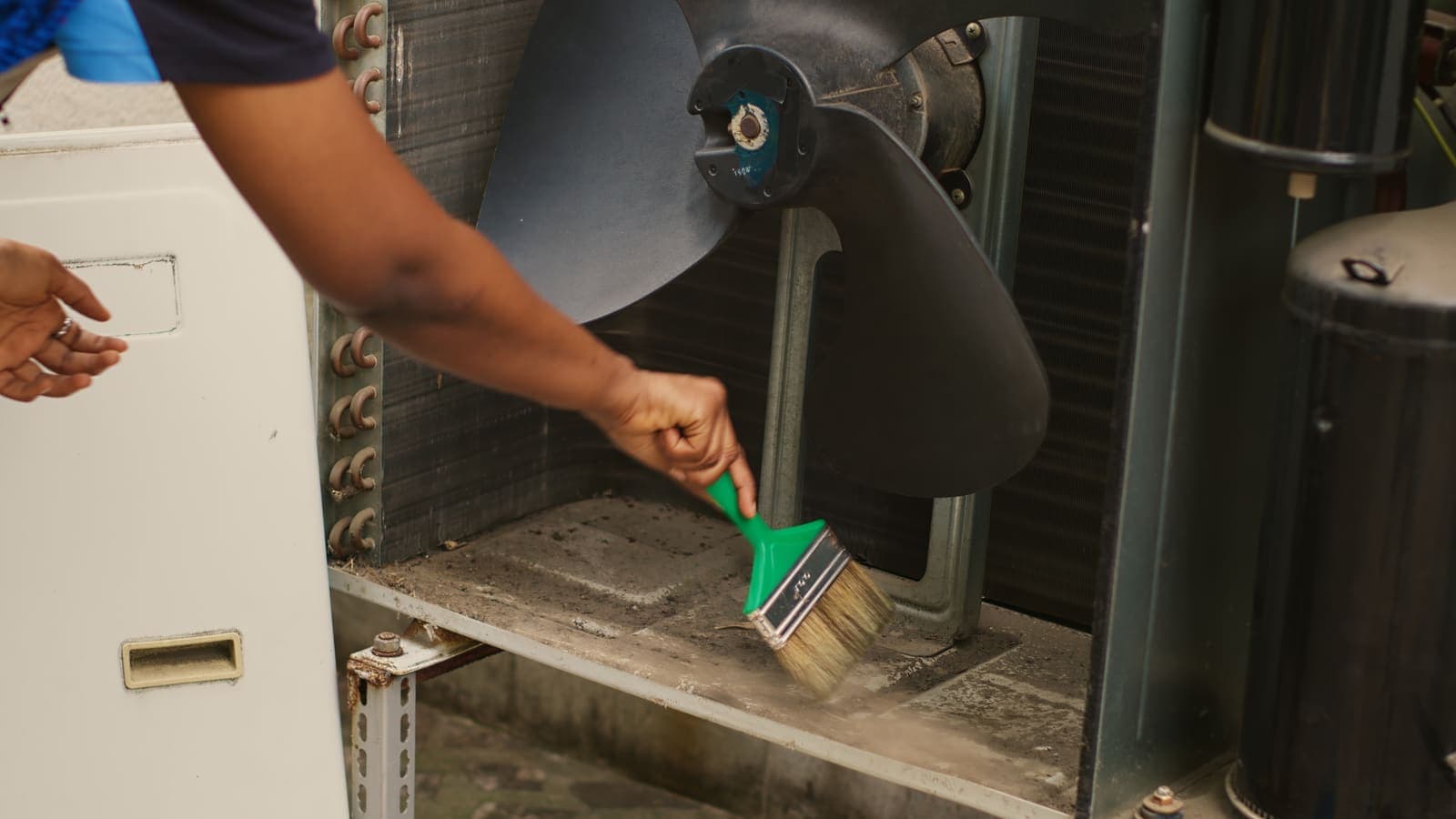
Most homeowners know the outdoor unit. Far fewer know about the part indoors that does the actual cooling. The evaporator coil sits inside your air handler or on top of your furnace, and it's where the heat and — just as important in the Carolinas — the humidity leave your air. It's also one of the more expensive components to replace, so it pays to understand it.
How it works. Cold liquid refrigerant flows through the coil's tubing while your blower pushes warm household air across its fins. The refrigerant absorbs heat from the air and evaporates into a gas, which travels outside to dump that heat. Because the coil is cold, moisture in the air condenses on it and drips into a drain pan below — that's your dehumidification. In a heat pump, the same coil runs in reverse in winter and gives off heat instead.
How it fails. The most common failure is a refrigerant leak. Thin copper tubing develops microscopic pinholes over time — a process called formicary corrosion, linked to humidity and to everyday household chemicals in the air (cleaners, adhesives, off-gassing from new building materials). Many manufacturers have moved to aluminum coils partly for this reason. The other big problem is dirt: a coil clogged with dust acts like a blanket, cutting airflow and cooling, and often leads to the coil freezing solid.
Symptoms: the system runs but doesn't cool well, refrigerant needs topping off every year or two (it's a sealed system — if it's low, it's leaking), ice forming on the coil or the refrigerant lines, a hissing sound near the indoor unit, higher humidity indoors, water overflowing the drain pan as ice melts, and rising electric bills.
What replacement costs. Evaporator coil replacement typically runs about $1,200–$3,000 installed, depending on the coil's size and type, how hard it is to reach, and the refrigerant involved. If your system is under its parts warranty — commonly 10 years when registered — the coil itself may be covered, leaving labor and refrigerant, often $600–$1,400.
The refrigerant wrinkle. Systems installed before 2025 generally use R-410A, and a replacement coil has to match. R-410A is still available for service but getting more expensive as production phases down. If your system is older, out of warranty, and needs a coil, this is the moment to price a full replacement alongside the repair — putting a $2,500 coil into a 13-year-old system with an aging compressor is often money poorly spent. On a system under 8 to 10 years old, replacing the coil usually makes sense.
Prevention is cheap: change filters on schedule (the filter exists to protect this coil), have the coil inspected and cleaned during annual maintenance, and keep the condensate drain clear. A properly maintained coil can last the life of the system.
Reinhardt Heating and Air finds and fixes refrigerant leaks and replaces evaporator coils across Lincoln, Gaston, Mecklenburg, and Catawba counties. We'll check your warranty first and price the repair and the replacement side by side, so you can make the call with real numbers.