

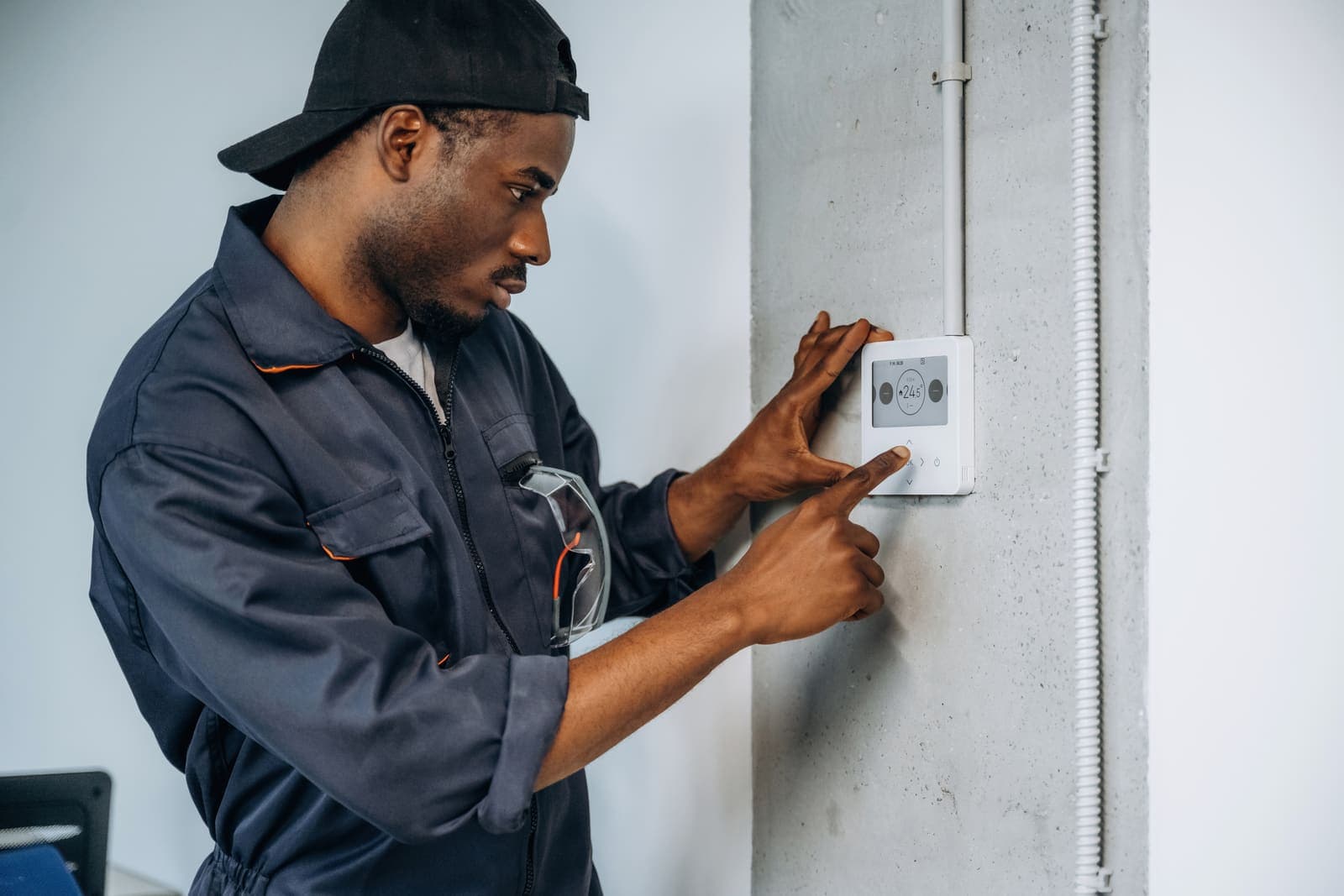
Replacing a thermostat is about the least expensive thing you can do to a heating and cooling system, and in many homes it's also one of the most noticeable. But the quotes vary a lot — a basic unit is a cheap hardware-store part, while a smart thermostat with new wiring is a real service call. Here's what each option costs and what determines the number.
By type. A basic manual or non-programmable digital thermostat runs about $25–$75 for the part; installed, expect roughly $100–$200. A programmable thermostat (set schedules for weekdays and weekends) runs $40–$150 for the part and $150–$300 installed. A smart thermostat — Wi-Fi, app control, learning schedules, remote sensors — runs $130–$300 for the part, and $250–$500 installed. Add $100–$250 if the installation needs a new common wire (more on that below).
What drives the price up. The wiring is the big variable. Many homes around here built before the 2000s have four-wire thermostat cable with no C-wire, and most smart thermostats need one for continuous power. Solutions range from an adapter kit to running new cable from the furnace or air handler, and the cost depends on how far and how hard that run is. Heat pump systems add a little complexity (the O/B reversing valve wire and auxiliary heat need to be configured correctly), and zoned homes with multiple thermostats multiply everything.
Is a smart thermostat worth it? Manufacturers commonly claim 8–15% savings on heating and cooling, and for homes where people are away during the day or forget to adjust the setting, that's realistic. For a household that's home all day and keeps a steady setpoint, the savings shrink — the main benefits become remote control, scheduling, and useful runtime data. In our climate, one real advantage is heat pump management: a well-configured smart thermostat avoids triggering the expensive electric backup heat unnecessarily, which a careless setback on an old thermostat does all winter.
When to replace rather than repair. Thermostats rarely get repaired; they get replaced. Replace it if it's reading inaccurately, if it's over 10–15 years old, if it's a mercury-bulb type (still common in older homes), if it's a mechanical dial, or if you want scheduling and remote control. We covered the symptoms of a failing thermostat in a separate guide.
DIY or professional? A like-for-like swap of a basic thermostat is a reasonable DIY job: photograph the wiring, label each wire, match the terminals. A smart thermostat on a heat pump, a system with no C-wire, or any wiring that doesn't match the standard colors is where we see the most DIY mistakes — a miswired O/B terminal means a heat pump that cools when it should heat, and a wrong connection can take out the control board, a repair that costs more than the thermostat.
Reinhardt Heating and Air installs and configures thermostats of every type across Lincoln, Gaston, Mecklenburg, and Catawba counties, including sorting out C-wire problems and setting up heat pump auxiliary heat correctly. Ask about it during your fall tune-up — it's a quick add-on while we're already there.